

Visa Guide for Students: Step by Step
Background
If you just receive an offer letter from your dream school or a confirmation letter for a Scholarship, congratulations. You have made it. The next step is planning your departure.
Apply for a passport
Get your passport ready because this is the beginning of a new stage of the game. If you already have the passport, skip to the next step.
Now no one will tell you this, but you want to dress up nicely and do your hair/makeup since you will have this photo on the passport for at least 5 years from now on. It should be satisfying, right?
Take all your documents and visit your nearest passport office. It can take up to one week for an urgent passport to get delivered and up to 20 days for normal delivery.
Pro tip: Be very careful at this stage and make sure every detail in your passport is correct and corresponds to all your academic credentials. Double-check your date of birth and all spellings.

Apply for U.S Visa
Now depending on your sponsorship, your visa category will be different. I’ll go through the details here:
If you are sponsoring your degree yourself, or a professor/university is sponsoring you, you will be applying for an F-1 visa based on an I-20 form from your school.
Look out for the email from a focal person at your department; it will have information about your SEVIS ID. You will need to pay a SEVIS fee and once you get your I-20 in hand, you can apply for an F-1 visa.
If you are on a state-sponsored scholarship, like HEC or Fulbright, you will be applying for a J-1 visa based on DS-2019 provided by the program sponsor.
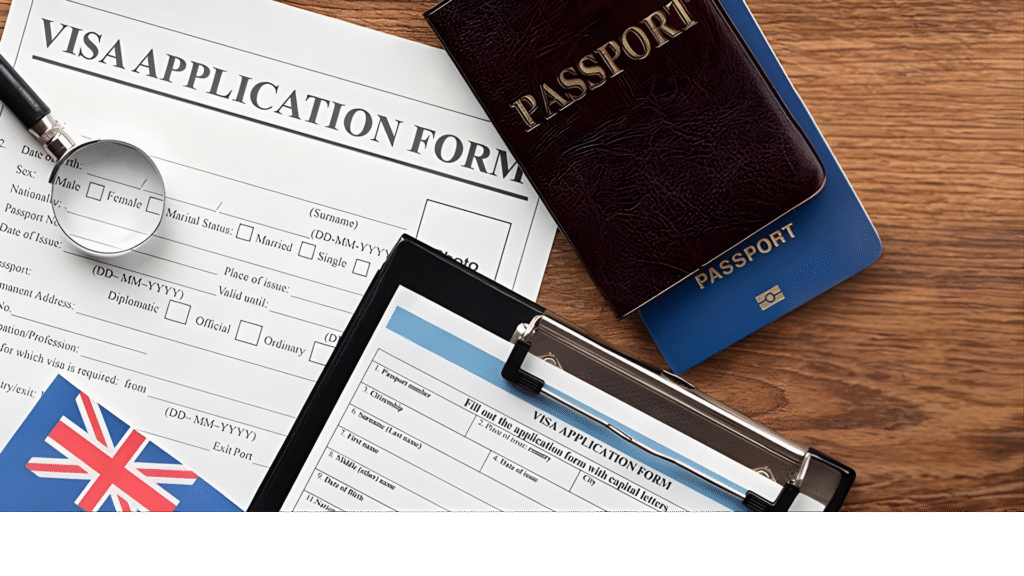
Applying for dependent’s visa:
If you plan to sponsor your family while being on an F-1 visa, that will be through the international services at your university, and you will apply for an F-2 visa for your dependents.
Similarly, for J-1 visa holders, a spouse or family visa would be J-2. The notable difference is that J-2 visa holders are authorized to work in the U.S., unlike F-2 visa holders.
Problem Statement
When it comes to the visa interview, first of all, your whole picture is important. That includes your body language, your confidence and positivity, and your clear and concise communication.
For starters, don’t fear the rejection and be hopeful. Trust yourself if you have done your homework well. Don’t try to flatter or give long answers, only tell what you are asked and answer the question directly, no hereabouts or background stories. Communicate very clearly so that they are able to hear and understand you.
Many students don’t understand what the visa officer is looking for, and even good profiles end up getting rejected.
Examples
Scenario 1 – Good profile but rejected:
A student has excellent academics and a strong scholarship but doesn’t communicate clearly in the interview. The visa officer doubts their credibility and commitment.
Scenario 2 – Average profile but accepted:
Another student has an average profile but presents themselves confidently, has clear documents, and demonstrates commitment. The officer is convinced, and the visa gets approved.
Tips, Methods, and Guidelines
3 Cs of Visa Interview
Have you considered what can be the 3 Cs for a visa interview? Have you wondered what visa officers are actually assessing? It’s only 3 things, and all their questions revolve around these.
The 3 Cs of a visa interview: Credibility, Cost, and Commitment.
Credibility means you have to establish that you are a genuine student, have study-related goals, and your profile is sound. The university you chose suits your educational needs and is not just a random university to get away out. You are not hiding anything, and you are showing exactly who you are.
To sum up, your academic profile, your spoken skills, and the university you chose matter a lot.
Cost means that you are financially secure and able to fund your studies. This part becomes easier if you have a fully funded scholarship.
In all other cases, you need to show a strong financial sponsorship which is legitimate. Your immediate family members can sponsor you, and they should seem reasonably strong themselves to be able to support.
Sponsorship from other relatives and a mismatch between the financial condition of sponsor and the bank statement becomes shady.
Commitment is the most important C; you won’t be able to dodge that easily. Commitment to your own self , your country and the U.S Law.
Commitment to yourself means you are passionate about your work and have sincere plans. You are not willing to use the education as an opportunity to run away from your area of study and choose something else when land in the U.S.
Commitment to the country means you have to show strong ties with your country, and that you want to come back. Having a family or job back home is a good tie but that alone is not enough. Make no mistake and keep your mind off additional thoughts; VO will know if you are being tricky.
Last thing is Commitment to law: Sadly, many students get involved in illegal jobs to support themselves or use petty tactics to get citizenship and settle in another country. This is a violation of your visa status, and VOs will read that. So be a responsible citizen and don’t show such signs in the interview.
Communication
Your whole picture is important body language, confidence, positivity, and clear communication. Don’t give long answers or try to flatter the officer. Only answer what is asked directly.
Conclusion
Visa preparation requires careful attention to every detail from passport accuracy to financial documentation, to interview communication.
Remember the 3 Cs: Credibility, Cost, and Commitment.